
Democratizing the
carbon market
zeroCO2 lowers the barriers to accessing the voluntary carbon credit market for small landowners, with transparency and innovation
Five principles underpin every Selva carbon credit
Additionality
The project would not have happened without the revenue from credits. We demonstrate this against a baseline scenario with three tests (financial, regulatory and common practice) and by comparing the forest's growth with the surrounding forests.
Dynamic accounting
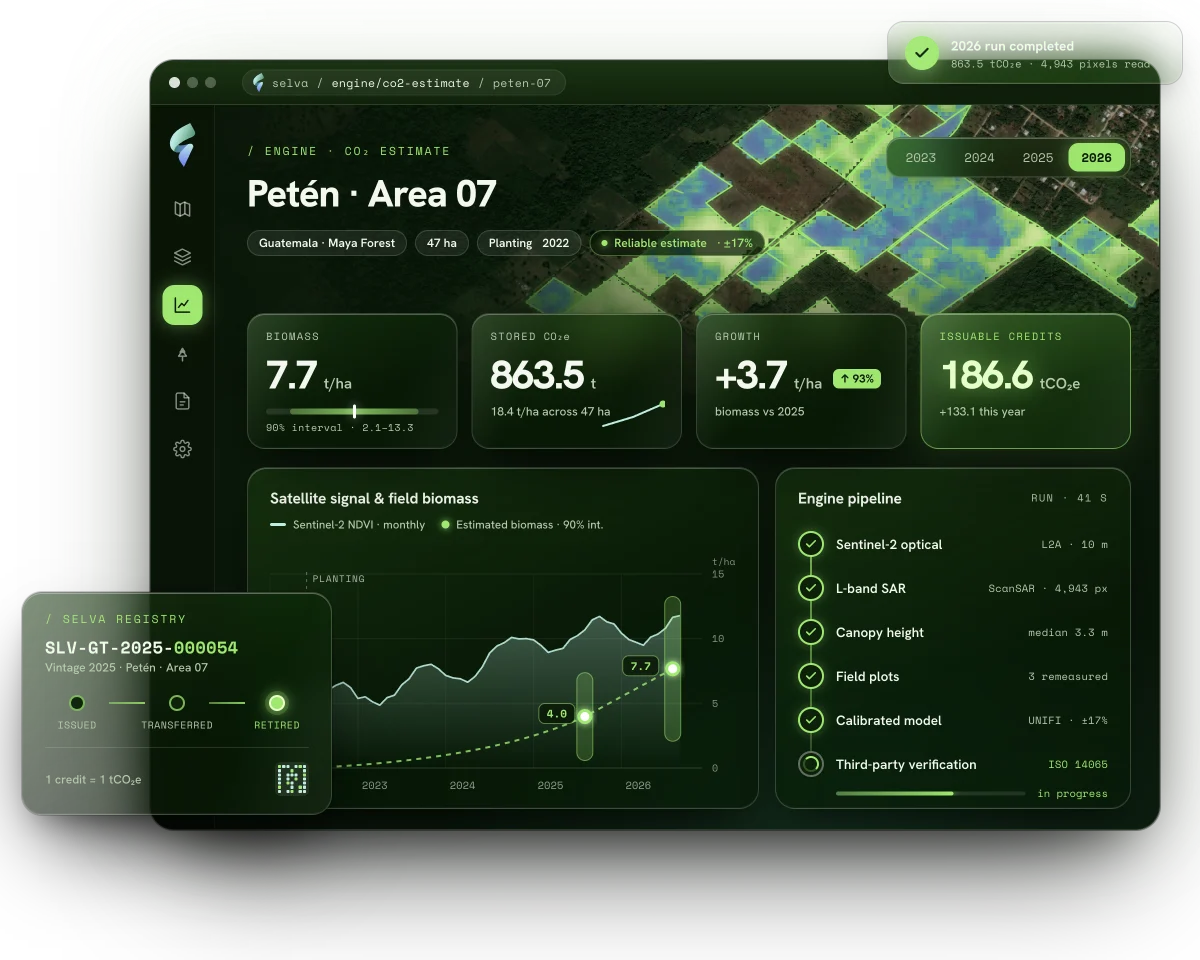
Our proprietary model combines machine learning, remote sensing, field data and physiological tree parameters to measure carbon with precision.
Satellite monitoring
Every year we analyze the satellite imagery of every project to measure forest cover and detect disturbances such as logging, fires or forest loss.
Permanence
Every project assesses reversal risks: fires, pests, legal and financial risks. A share of credits set aside as a buffer, calculated according to risk, protects the project's durability.
Co-benefits
Beyond carbon, we measure social impact (local communities, gender equality) and biodiversity. 50% of revenue goes to farming communities.
The market's reference standards are designed for large projects: €100–200k in costs, 200–300 pages of documentation, an average size of 500 hectares1. Selva uses satellite and AI instead of on-the-ground measurements, so small landowners can access the market too. What changes if you own land →
From land to certified credit: 9 steps
Registration
The landowner registers on the Selva platform with their identifying information.
Property details
Proof of ownership is provided through cadastral records or notarial deeds.
Project application
The project name, duration, specific areas and tree species are entered.
Eligibility feedback
The Selva team provides feedback on the project's eligibility within a few weeks.
Independent validation
An independent third-party verifier checks the eligible projects.
Selva Registry
The project becomes official and the credits are available for purchase.
Credit purchase
Buyers purchase the credits and the revenue-sharing mechanism is established.
Payment to landowners
The revenue is transferred to the landowner according to the agreements.
Long-term management
Annual monitoring, risk hedging and updates ensure permanence.
Who governs the standard and who verifies
Selva defines the standard, keeps the registry and sells the credits. That is why project verification is not entrusted to the Selva team but to an independent third party, and the standard is governed by an Advisory Board.
Advisory Board
Governs the Selva framework, i.e. the rules by which projects are assessed and credits are issued.
zeroCO2
Manages the platform and the Selva Registry and issues the credits (Selva Carbon Credits).
Independent third-party verifier
Verifies every project before credits are issued. The reference standard for verifiers is ISO 14065.
How to verify a Selva credit
Unique code
Every credit sold is associated with a unique code in the Selva Registry.
Public registry
Anyone can consult the registry: for each project it shows the credits issued, transferred and retired.
Retirement
When you use a credit to offset, it is retired and taken out of circulation: it cannot be resold. This is the data to cite in your report.
A scientific, transparent and open framework
The Selva GHG Standard defines how Selva Carbon Credits (SCC) are created. Every process ensures the issuance of a single credit for each tonne of CO₂ removed.
The framework is based on: UNI 11646:2021, ISO 14064, ISO 14065, and United Nations CDM methodologies.
Have doubts about the standard?
Are you with us?
Want to buy credits?
Buy verified carbon credits to offset your organization's emissions.
Buy credits →
Have land?
Transform your forest into economic income by accessing the carbon market for free.
I own land →